


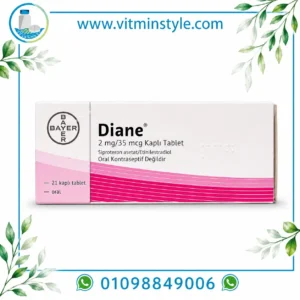
Diane 35 by Bayer – Cyproterone Acetate 2mg / Ethinylestradiol 35mcg | 21 Coated Tablets
Key Facts
| Brand | Bayer |
|---|---|
| Active Ingredient 1 | Cyproterone Acetate 2 mg |
| Active Ingredient 2 | Ethinylestradiol 35 mcg |
| Form | Coated Tablet — Oral |
| Quantity | 21 Tablets per box |
| Country of Origin | Germany |
| Prescription | Required (Rx Only) |
| Storage | Below 25°C, away from children |
| Barcode | 8699546120031 |
| License No. | 2015/516 |
Table of Contents
- What Is Diane 35?
- How Does It Work?
- Main Benefits
- Real Use Cases
- Who Is It Best For?
- Who Should Avoid It?
- How to Use Correctly
- Best Time to Use
- Expected Results Timeline
- Common Mistakes
- Myths vs Facts
- Drug Interactions
- Contraindications
- Required Tests
- What to Eat With It
- Effect on Other Medications
- When to See a Doctor
- Frequently Asked Questions
- Trusted References
- Medical Disclaimer
Introduction
Diane 35 tablets from Bayer are a well-established hormonal treatment used specifically for androgen-dependent skin and hair conditions in women. Unlike many other hormonal medications, Diane 35 is not classified as an oral contraceptive — a fact clearly stated on the original packaging. It combines two active ingredients that work together to reduce the effects of male hormones (androgens) in women, leading to visible improvements in acne, oily skin, and excessive hair growth.
What Is Diane 35?
Diane 35 is a coated oral tablet manufactured by Bayer Weimar GmbH in Germany. Each tablet contains Cyproterone Acetate 2 mg and Ethinylestradiol 35 mcg. It is licensed for the treatment of androgen-dependent conditions in adult women, such as moderate to severe acne, seborrheic dermatitis, and hirsutism (unwanted facial or body hair). The product is distributed under a Turkish license (No. 2015/516) and is intended for oral use only.
How Does It Work?
Diane 35 works through a dual mechanism:
- Cyproterone Acetate is an anti-androgen. It blocks androgen receptors in target tissues, reducing the stimulating effect of male hormones (testosterone and DHT) on skin and hair follicles.
- Ethinylestradiol is a synthetic estrogen. It supports hormonal balance, reduces sebum production, and contributes to a clearer complexion.
Together, these two ingredients reduce sebaceous gland activity, limit acne formation, decrease oiliness, and slow down the growth of unwanted hair over time.
Main Benefits
- Significant reduction in androgen-related acne
- Reduction in sebum (oil) production and oily skin
- Decrease in seborrheic dermatitis symptoms
- Slowing and reduction of hirsutism (unwanted hair growth)
- Improvement in skin texture and appearance over time
- Trusted Bayer formulation with decades of clinical use
Real Use Cases
- Adult women with persistent hormonal acne that did not respond to topical treatments
- Women with diagnosed polycystic ovary syndrome (PCOS) and related skin/hair symptoms
- Women experiencing excessive facial or body hair due to elevated androgen levels
- Dermatologist-prescribed cases of severe seborrhea with associated hair loss
Who Is It Best For?
Diane 35 is best suited for adult women who have been diagnosed with androgen-dependent conditions and have received a prescription from a licensed physician or dermatologist. It is particularly relevant for women with confirmed elevated androgen levels and skin or hair symptoms that have not improved with standard topical treatments.
Who Should Avoid It?
- Pregnant women (clearly stated on packaging: “Do not use during pregnancy”)
- Women with a history of or current thromboembolic disorders (blood clots)
- Women with severe liver disease or liver tumors
- Women with undiagnosed vaginal bleeding
- Women with known hypersensitivity to cyproterone acetate, ethinylestradiol, lactose, or sucrose
- Women with a history of severe depression
- Women with cardiovascular disease or stroke history
- Smokers above age 35 (due to increased cardiovascular risk)
How to Use Correctly
Always follow the prescribing physician’s instructions. The general protocol for Diane 35:
- Take one tablet per day for 21 consecutive days.
- Start on the first day of your menstrual cycle.
- After completing the 21 tablets, take a 7-day break (no tablets).
- Begin the next pack after the 7-day break, even if bleeding has not stopped.
- Swallow the tablet whole with water, with or without food.
- Take it at the same time every day for best results.
Do not start or stop this medication without medical supervision.
Best Time to Use
Take Diane 35 at the same time each day — morning or evening, whichever is most consistent for your routine. Taking it with a meal may help reduce nausea, especially in the first few weeks of use.
Expected Results Timeline
| Timeframe | Expected Change |
|---|---|
| 2–4 weeks | Reduction in skin oiliness may begin |
| 1–3 months | Noticeable improvement in acne and seborrhea |
| 3–6 months | Significant acne reduction; beginning of hirsutism improvement |
| 6–12 months | Maximum benefit for hirsutism and skin tone |
Individual results vary. Consistent use as prescribed is essential for best outcomes.
Common Mistakes to Avoid
- Stopping the medication abruptly without consulting a doctor
- Skipping tablets irregularly
- Using Diane 35 as a contraceptive — it is not licensed as an oral contraceptive
- Purchasing opened or damaged packaging
- Using without a valid prescription
- Self-diagnosing and self-prescribing without lab confirmation of androgen excess
Myths vs Facts
| Myth | Fact |
|---|---|
| Diane 35 is a contraceptive pill | It is NOT licensed as a contraceptive. It is a hormonal treatment for androgen-dependent conditions. |
| Results appear within days | Meaningful improvement typically takes 1–3 months of consistent use. |
| It can be taken without a prescription | Diane 35 is a prescription-only medication requiring medical evaluation. |
| It causes permanent weight gain | Some fluid retention may occur initially; significant weight gain is not a confirmed effect for all users. |
Drug Interactions
Diane 35 may interact with the following medications. Always inform your doctor about all medicines you are currently taking:
- Anticonvulsants (phenytoin, carbamazepine, phenobarbital) — may reduce effectiveness
- Rifampicin / Rifabutin — significantly reduces plasma levels of active ingredients
- Antifungals (ketoconazole, itraconazole) — may increase hormone levels
- HIV protease inhibitors and non-nucleoside reverse transcriptase inhibitors — may alter hormone levels
- St. John’s Wort (Hypericum perforatum) — herbal supplement that can reduce efficacy
- Ciclosporin — ethinylestradiol may increase plasma levels
- Lamotrigine — may reduce its plasma levels, potentially increasing seizure risk
Contraindications
Diane 35 must not be used in the following situations:
- Current or history of venous or arterial thrombosis
- Pregnancy or suspected pregnancy
- Breastfeeding
- Severe or multiple risk factors for arterial or venous thrombosis
- Severe hepatic disease or liver tumors (benign or malignant)
- Severe renal or adrenal insufficiency
- Known or suspected sex hormone-dependent malignancies
- Undiagnosed vaginal bleeding
- Hypersensitivity to any component (including lactose or sucrose)
- Diabetes mellitus with vascular complications
Required Tests Before and During Use
Your doctor may request the following before prescribing or continuing Diane 35:
- Hormonal profile — Total testosterone, free testosterone, DHEA-S, LH, FSH
- Liver function tests (LFTs) — ALT, AST, bilirubin
- Blood pressure measurement — Baseline and periodic monitoring
- Pelvic ultrasound — To rule out ovarian cysts or PCOS confirmation
- Lipid profile — Cholesterol, triglycerides
- Coagulation screen — Especially in women with family history of blood clots
- Blood glucose / HbA1c — In women with risk factors for diabetes
- Pap smear / cervical screening — As part of routine gynecological monitoring
What to Eat With It
No specific diet is required, but the following nutritional habits support better outcomes during treatment:
- Low-glycemic diet — Reduces insulin-driven androgen production (beneficial for acne and PCOS)
- Increase zinc-rich foods — Pumpkin seeds, legumes, nuts (zinc has anti-androgenic properties)
- Omega-3 fatty acids — Fatty fish, flaxseeds, walnuts (anti-inflammatory, supports skin health)
- Reduce dairy and high-sugar foods — These may exacerbate androgen-related acne
- Adequate folate / B-vitamins — Green vegetables, whole grains
- Stay well-hydrated — Supports liver metabolism of hormones
Effect on Other Medications
Diane 35 may affect the plasma concentrations and effectiveness of other drugs you take:
- It may increase blood levels of ciclosporin — monitor for toxicity
- It may decrease blood levels of lamotrigine — seizure risk in epilepsy patients
- It may affect the metabolism of medications processed by liver enzymes (CYP3A4 pathway)
- Inform all treating physicians (dermatologist, gynecologist, GP) of its use before starting any new medication
When to See a Doctor Immediately
Stop using Diane 35 and seek immediate medical attention if you experience:
- Sudden leg pain, swelling, or redness (possible deep vein thrombosis)
- Sudden chest pain or shortness of breath (possible pulmonary embolism)
- Severe headache, vision changes, or sudden numbness (possible stroke)
- Yellowing of the skin or eyes (jaundice — liver involvement)
- Unusually heavy or irregular vaginal bleeding
- Severe abdominal pain
- Signs of severe allergic reaction (rash, swelling, difficulty breathing)
- Significant mood changes or depression
Vitamin Style Expert Tip
Frequently Asked Questions (FAQ)
1. Is Diane 35 a contraceptive pill?
No. Diane 35 is not licensed as an oral contraceptive. It is prescribed for androgen-dependent conditions such as acne and hirsutism. Its packaging explicitly states it is not an oral contraceptive.
2. How long does it take to see results with Diane 35?
Most patients begin to see improvement in skin oiliness within 2–4 weeks. Significant acne improvement typically appears after 1–3 months. Hirsutism improvements may take up to 6–12 months of consistent use.
3. Can I take Diane 35 without a prescription?
No. Diane 35 is a prescription-only medication. It must be prescribed by a licensed physician after appropriate clinical evaluation and, where necessary, lab testing.
4. Can I use Diane 35 if I am pregnant?
No. The use of Diane 35 during pregnancy is contraindicated. The packaging clearly states “Do not use during pregnancy.” If you become pregnant while taking it, stop immediately and consult your doctor.
5. What are the most common side effects of Diane 35?
Common side effects may include nausea, breast tenderness, mood changes, headache, and reduced libido. Less commonly, some patients experience weight changes or breakthrough bleeding. Serious but rare risks include blood clots (thrombosis). Always report side effects to your doctor.
6. Does Diane 35 contain allergens?
Yes. Diane 35 contains lactose and sucrose as inactive ingredients. Women with known intolerance to these substances should inform their doctor before use.
7. Can I stop Diane 35 whenever I want?
You should not stop Diane 35 abruptly without consulting your prescribing physician. Sudden discontinuation can lead to a return of symptoms and hormonal fluctuations.
8. Where is Diane 35 manufactured?
Diane 35 is manufactured by Bayer Weimar GmbH und Co. KG, Industrial Park North, Weimar, Germany.
9. How should Diane 35 be stored?
Store below 25°C at room temperature. Keep out of the reach and sight of children. Do not use if the packaging is damaged or already opened.
10. Is Diane 35 suitable for teenagers?
Diane 35 may be prescribed to adolescent girls after menarche (onset of menstruation) when androgen-dependent conditions are confirmed. However, it must always be prescribed and supervised by a physician.
Trusted References
- PubMed Central – Cyproterone Acetate in Androgen-Dependent Dermatoses
- European Medicines Agency – Cyproterone-Containing Medicines Review
- PubMed – Ethinylestradiol and Hormonal Treatments
- Bayer Official – Women’s Healthcare
- Drugs.com – Diane 35 Professional Information


Reviews
There are no reviews yet.